


Dr. Panda Train
Dr. Panda
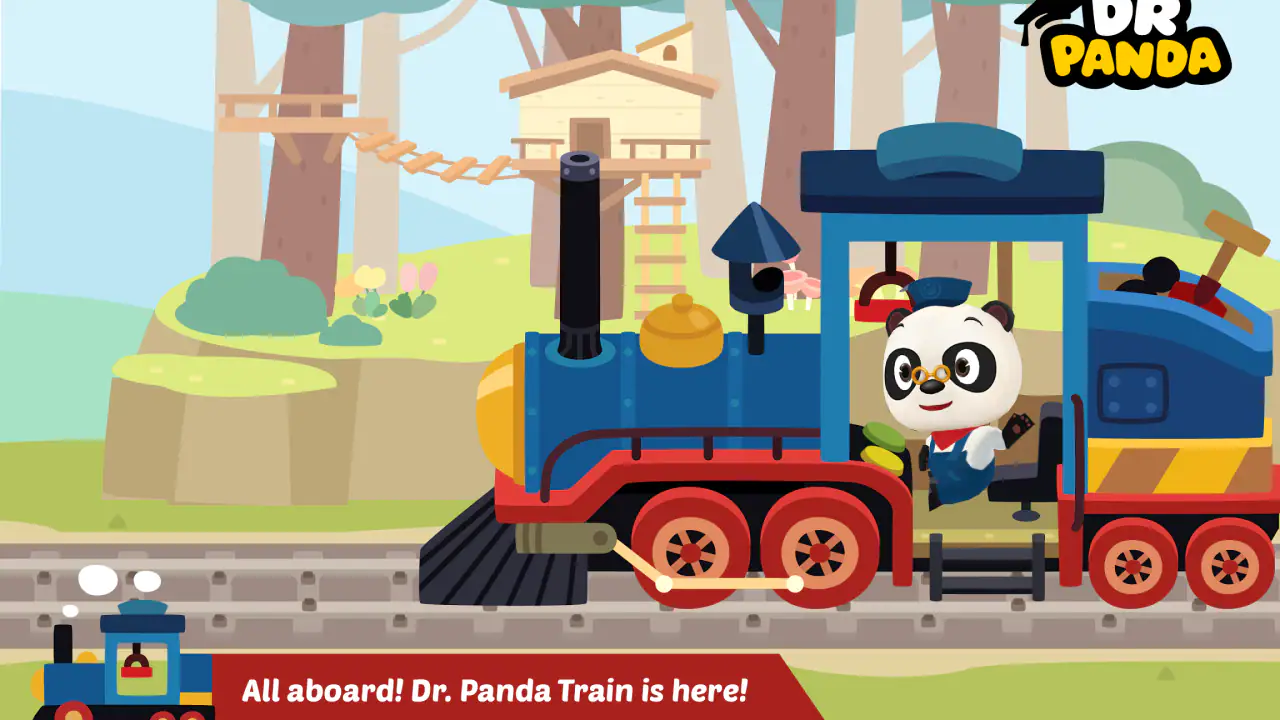
I approached Dr. Panda Train as a small child-friendly world rather than a conventional level-based game. The central idea is simple: I take control of a train, move through a colorful setting, help passengers, and handle cargo. That simplicity is exactly what makes it approachable for young players, although it also defines its limits. This is an educational game from Dr. Panda for children who enjoy pretend play, vehicles, and short, open-ended activities more than competition or complicated rules.
My first impression is that it works best when an adult treats it as a guided play experience. A child can explore the train and its surroundings without needing to understand a long tutorial or master difficult controls. The game’s appeal comes from making ordinary train jobs feel interactive: getting people where they need to go, paying attention to what is around the train, and deciding what to do next. It is a gentle introduction to sequencing and responsibility through play, not a reading-heavy lesson disguised as entertainment.
How the train experience feels today
The current version is 26.3.13, and the game remains a focused experience rather than a large collection of unrelated mini-games. That focus is useful for a preschool or early-primary player who may become overwhelmed by menus, currencies, unlock trees, or several competing objectives. I can hand the device to a child and explain the basic idea quickly: drive, notice the passengers, move cargo, and explore the route.
The controls are the most important part of the design. A young player does not need the precision expected by a racing game, and the train’s slower rhythm gives them time to understand what is happening. In my experience, this makes it suitable for children who are still developing coordination on a touchscreen. They can concentrate on cause and effect instead of reacting to a countdown or worrying about losing.
That relaxed pace also changes how the game should be used. It is not the kind of title I would choose for a child asking for constant surprises or a strong sense of progression. There is no obvious reason to rush through an activity. Instead, the value comes from repeating familiar actions in a different order and inventing small stories around the passengers and cargo. One child might treat the train as a delivery service; another might turn the journey into an imaginary trip with a destination and a purpose.
Related News






The educational element is subtle. The game does not need to stop and announce a lesson for a child to practice useful skills. Loading something, remembering who needs help, and following a sequence all encourage attention and planning. These are modest learning opportunities, but they are more natural than worksheets for a child who learns best by touching and experimenting.
A practical way to play with a child
I found the best everyday use case is a short shared session before dinner, during travel, or while waiting for an appointment. I would let the child choose the first action, then ask questions such as, “Who should we help next?” or “What do you think belongs on the train?” The questions turn passive tapping into conversation without taking control away from the child.
There is also a useful role-reversal exercise. After the child becomes comfortable, I would ask them to explain the train’s job to me. That encourages them to describe a sequence in their own words: first the passengers, then the cargo, then the journey. The game itself supplies the setting, while the adult adds the language and reasoning practice that a young player may not get from solitary play.
Gallery
Parents should not assume that the educational value depends on completing every available interaction. A child can benefit from choosing one small task and repeating it. In fact, pushing through too many activities can make the experience feel like an assignment. The strongest approach is to follow the child’s curiosity and use the train as a prompt for discussion.
What the developer’s approach gets right
Dr. Panda has built a reputation around accessible play, and that philosophy is easy to recognize here. The game keeps the main fantasy understandable: the player is not managing a complicated railway network but participating in the daily work of a train. That distinction matters for younger children, because it gives them a clear role without requiring them to read instructions or understand advanced systems.
The content rating is Everyone, which fits the calm, family-oriented presentation. I would still choose the game based on the child’s interests rather than age alone. A child who loves vehicles and pretend jobs may stay engaged for a long time, while a child who prefers puzzles, drawing, or fast action may lose interest quickly even though the content is appropriate.
The game’s paid price is $3.99. For me, that makes the decision different from trying a free download casually. The advantage is that the experience is presented as a complete purchase rather than something I would expect to manage through a stream of spending prompts. The trade-off is that parents should be confident their child enjoys open-ended train play before buying, because the game’s appeal depends more on repeated imaginative use than on a long campaign.
Its audience is also reflected in its reach: the game has passed 100K installs and carries a 3.7 average from 435 ratings. I read that as a sign of a recognizable but not universally loved experience. The score does not make me dismiss it, but it does reinforce my view that the game is highly dependent on the child’s temperament. A train fan may find it charming; a player looking for constant goals may find it limited.
What has changed and what that means for players
The game was released on Jun 21, 2017, so it is not a new arrival. Its current version shows that it has continued to receive product attention rather than remaining frozen at its original release. I would describe that as evidence of maintenance and evolution, not proof that the whole experience has been redesigned. The core identity is still the same: a child-friendly train world built around driving, passengers, and cargo.
That distinction is important for existing users. If a family already likes the game, a current version is reassuring because it indicates that the app remains part of the developer’s active catalog. However, I would not expect an update number by itself to transform the game into a deeper simulation or a broader educational curriculum. The enduring strength is the original play pattern, and the main question is whether that pattern continues to suit the child.
For someone returning after a long break, I would start with a fresh shared session rather than assuming the child will immediately notice technical changes. Ask the player to show what they remember, then observe whether the controls and activities still feel natural. This is a better test of the current experience than focusing on the version label. A young player’s expectations may have changed more than the game’s central design.
The same advice applies to families moving between devices. The minimum operating system is Android 7.0, so compatibility should be checked before installing on an older Android device. That requirement is practical rather than demanding by modern standards, but it still matters if the game is intended for a hand-me-down phone or tablet. I would verify the device first, especially when the purchase is made for a child’s dedicated device.
How it compares with the usual alternatives
Compared with a train simulator, this game is much less concerned with realism. There is no reason to expect detailed railway management, technical controls, or the satisfaction of mastering a complex route. That is a benefit for a young child who wants to pretend to be a train driver, but a weakness for an older player who wants authentic operations.
Compared with puzzle-based educational games, it offers less direct practice. A puzzle app may clearly target counting, spelling, matching, or memory. Here, learning happens through context and repetition. I prefer this approach for imaginative children who resist formal exercises, but I would choose a more structured educational title when I have a specific skill to reinforce.
Compared with free children’s games, the paid model is easier to evaluate emotionally. I am not entering the experience expecting a rotating set of rewards or advertisements to keep the child engaged. The downside is that there is no free trial implied by the price, so a parent needs to make a more deliberate choice. If the child has already shown a strong interest in trains, the purchase is easier to justify than if the game is being selected at random.
There is another important comparison: physical pretend play. A toy train set can offer more room for building, rearranging, and creating a physical story. This app offers immediate interaction without needing storage space or setup. I see it as a complement rather than a replacement. A child can use the digital train during a short waiting period, then return to physical play when there is room and time.
Small strategies that make the experience better
One useful strategy is to avoid taking over the controls. Adults often move quickly because they already understand the objective, but doing so removes the trial-and-error that gives the game its value. I would let the child make an inefficient choice, then ask what happened. The slow pace makes this possible without turning a mistake into a failure.
A second strategy is to create a simple mission before starting. For example, I might say that today the train needs to help every passenger before carrying cargo, or that we are going to notice every place we visit. The game becomes more engaging when the child has a small story goal, even if the app itself does not require one.
A third strategy is to use the cargo interactions for sorting language. I would ask the child to describe what is being loaded, where it should go, or what might happen if the train leaves too soon. This turns a visual action into vocabulary, prediction, and sequencing practice. It is a stronger use of the game than letting the child tap through everything while an adult looks away.
A fourth strategy is to stop while the child is still interested. Because this is open-ended play, there is no need to reach a dramatic ending. Ending after a successful small task makes it easier to return later and prevents the train from becoming another repetitive screen activity. Short sessions also suit the game better than expecting it to occupy a child for an entire afternoon.
Where the experience may fall short
The main limitation is depth. The same simplicity that makes the game welcoming can make it feel thin to children who want a challenge, a clear reward structure, or a strong sense of advancement. If your child asks why there are not more difficult routes, competitive goals, or increasingly complex responsibilities, this may not be the right long-term choice.
I also would not buy it as a substitute for a targeted learning tool. The game can support conversation about order, jobs, and observation, but it is not the first choice for teaching a particular academic topic. Parents looking for measurable practice should consider a dedicated educational app alongside it rather than expecting the train to cover every learning need.
Another possible friction point is the need for adult interpretation. The game’s actions are easy to understand, but the deeper educational benefits are not necessarily automatic. A child playing alone may simply enjoy driving and loading without thinking about sequence or responsibility. That is still valid play, but families buying it mainly for learning should plan to join occasionally and ask questions.
The rating of 3.7 also suggests that the experience will not satisfy everyone. I would be cautious about buying it for an older child simply because the content rating is broad. “Everyone” speaks to suitability, not complexity. A younger player may find the open-ended design liberating, while an older player may judge it by the standards of larger simulation or adventure games and feel that there is not enough to do.
I would also skip it if the child dislikes vehicles, pretend jobs, or repeating familiar actions. The train theme is not just decoration; it is the reason to play. A child who wants stories with dialogue, competitive races, or traditional levels will probably be happier elsewhere. In that situation, a puzzle game or a more structured adventure would offer clearer reasons to continue.
Questions I would settle before buying
Is it suitable for independent play? For a child who already understands basic touchscreen gestures, the controls should be approachable, but I would still supervise the first session. After that, some children can explore independently, while others will get much more from an adult who turns the activities into a conversation.
Will it keep a child busy for a long time? I would not use it with that expectation. Its best sessions are short or moderate, with the child returning because the train supports a new pretend scenario. If you need a title designed around extended progression, this is probably too light.
Does the purchase make sense? At $3.99, I see it as a low-cost paid activity for a child who already likes trains and open-ended play. The value is strongest when the app becomes part of a rotation that includes books, physical toys, and other creative activities, rather than being expected to deliver endless content on its own.
Can it support learning at home? Yes, but mainly through guided use. Ask the child to plan an order of tasks, describe what passengers need, or explain why cargo is being moved. Those prompts add reasoning and language practice without changing the game into a formal lesson.
What should I watch for over time? I would pay attention to whether the child invents new scenarios or simply repeats the same action without interest. If imaginative play is growing, the game is doing its job. If engagement fades quickly and the child is asking for more challenge, that is a clear signal to move to a more structured train, puzzle, or educational alternative.
My recommendation for the right family
I recommend Dr. Panda Train to families looking for a calm, accessible digital toy with an educational flavor. Its strongest qualities are the understandable train theme, the forgiving pace, and the opportunity to practice sequencing through pretend work. I especially like it for a younger child who enjoys vehicles and benefits from an adult joining in with questions rather than instructions.
I would not recommend it as a universal learning solution or as a replacement for a full train simulator. The open-ended design can feel limited, and the educational results depend heavily on how the child plays. A family seeking clear lessons, measurable exercises, or increasingly difficult challenges should choose a more specialized app.
Still, there is value in a game that does not pressure a child to win. When I use it as a starting point for storytelling and simple planning, the train becomes more than a sequence of taps. It gives a child a manageable world in which helping passengers and moving cargo feel meaningful. For the right player, that modest idea is enough to create relaxed, repeatable play.
FAQs for Dr. Panda Train
What is Dr. Panda Train, and what can children do in the game?
Dr. Panda Train is a child-friendly interactive game in which players take control of a colorful train and explore different locations with animal passengers. Children can choose who rides, help passengers board, discover playful surprises, and interact with objects along the route. The experience is designed around open-ended play rather than strict goals, timers, or complicated rules.
Is Dr. Panda Train suitable for young children?
The game is generally aimed at preschool and early-school-age children, with simple controls and an interface that is easy to understand. Most activities rely on tapping, dragging, and exploring, so children can play without advanced reading skills. Parents should still check the current store age rating, supported devices, and any regional content differences before downloading it.
Does Dr. Panda Train require an internet connection to play?
Dr. Panda Train is primarily designed as an offline-friendly experience after installation, which makes it convenient for travel or situations without reliable mobile data. However, an internet connection may be needed for the initial download, updates, restoring purchases, or accessing store-related services. It is a good idea to launch the game once while online before giving it to a child offline.
Are there advertisements or in-app purchases in Dr. Panda Train?
The availability of advertising and in-app purchases can depend on the version, platform, and store listing. Dr. Panda games are commonly presented as child-focused products, but parents should review the official Google Play or App Store page for the exact purchase model before installing. To avoid accidental transactions, enable parental controls and require authentication for purchases on the device.
Is Dr. Panda Train educational, and can parents play with their children?
Dr. Panda Train is better understood as an imaginative play app than as a formal educational lesson. It can encourage creativity, storytelling, role-play, visual attention, and basic cause-and-effect learning as children interact with passengers and the environment. Parents can join by asking children where the train is going, who is traveling, and what might happen at the next stop.
Pros
- Simple controls make it easy for young children to start playing independently.
- Bright animations and friendly characters create an inviting preschool experience.
- Open-ended train play encourages exploration without pressure to complete levels.
- Works well for short play sessions during travel or quiet time.
- Child-friendly interactions avoid complicated menus and confusing objectives.
Cons
- Gameplay may feel repetitive once children have explored the main train activities.
- Limited challenge means older preschoolers may lose interest quickly.
- Some features and content may require an in-app purchase.
- Parents may find the educational depth lighter than in structured learning apps.
- Performance can vary on older devices with limited storage or memory.


